
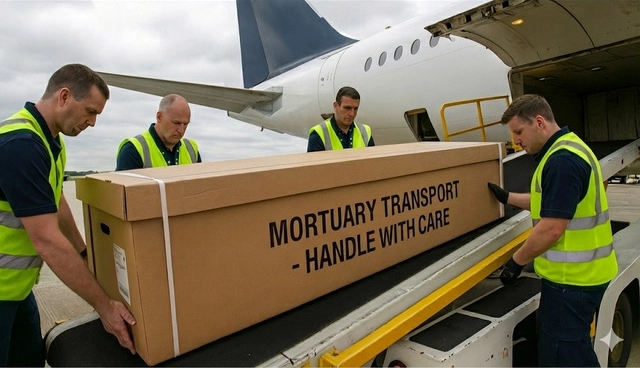


Short answer: a body travels as air cargo, not as a passenger, and only a registered shipper such as a funeral home can send it. The family doesn’t book the flight. A funeral home near the place of death prepares the remains, handles the permits, and books the airline’s cargo service; a second funeral home collects at the other end.
If someone you love has died far from home, this guide explains what happens between the two funeral homes, what the airline needs, how long it takes, and what you can do to keep it simple. For what it costs, see our guide to funeral shipping costs.
Still have questions?
Call or text us now and talk it through with a real person.
Who can ship human remains by air?
Airlines accept human remains through their cargo departments, and only from shippers they have approved. The National Funeral Directors Association (NFDA) explains that funeral homes “are required to register as a known shipper with each airline they use to ship remains,” and that an airline may refuse remains from a shipper that isn’t registered (NFDA).
Alaska Air Cargo, for example, tells customers they “must work with their preferred funeral home or medical institution” to ship remains (Alaska Air Cargo). In practice, that means a family can’t simply buy a cargo booking and take a loved one to the airport. The first call goes to a funeral home, or to the assistance line of a plan that arranges it for you.
How a body is flown home, step by step
- Collection. A funeral home near the place of death brings the deceased into its care from the hospital, residence or medical examiner.
- Death certificate and permits. The death must be certified, and the remains need the paperwork the law requires for transport, such as a burial-transit or removal permit. If the death was sudden or accidental, a coroner may need to determine the cause first, which can add time (FAQ).
- Preparation. The remains are prepared for travel: embalmed, or cremated at the place of death if that’s the family’s choice.
- The shipping container. The remains are placed in a sealed container that meets the airline’s rules (more on this below).
- The cargo booking. The sending funeral home books the shipment with an airline it is registered with and delivers it to the airline’s cargo facility.
- Receiving. A funeral home in the home town collects the remains at the destination airport and takes them into its care for the funeral, burial or cremation.
Two funeral homes are involved, and each charges for its part. Under the FTC’s Funeral Rule, “forwarding of remains to another funeral home” and “receiving remains from another funeral home” each appear on a funeral home’s General Price List as a single price that must include all related charges, so you can ask both homes for those two prices up front (FTC).
What the airline requires to ship a body

NFDA notes that “each airline sets its own documentation requirements and procedures for transporting remains as cargo” (NFDA). Alaska Air Cargo’s published rules give a typical picture (Alaska Air Cargo):
- A leak-proof inner container. The remains must be “adequately secured in a tightly closed, leak proof container.”
- An outer shipping container of wood, metal, canvas, plastic or paperboard. Containers over 400 pounds need at least six handles, and the container must fit the aircraft’s cargo limits.
- Documents: a death certificate signed by a physician or health officer, or a burial removal and/or transit permit, as the law requires at the origin and destination.
Some airlines don’t carry remains on every route. Alaska Air Cargo, for instance, says it can’t accept shipments of human remains outside the United States. Finding a carrier and routing is part of what the sending funeral home, or a repatriation specialist, does.
Is embalming required to fly a body?
Not under federal law. The FTC states that “federal law does not require embalming under any circumstances,” though state or local law may require it in some situations (FTC). Airlines and, abroad, destination countries set their own rules too, so the sending funeral home will tell you what applies to the route. Cremation at the place of death avoids most of these questions, and the cremated remains can then travel home separately.
One call instead of two funeral homes and an airline
The $450 plan arranges and pays for the whole journey home
If you die 75 miles or more from home, in the U.S. or overseas, the DFS Travel Protection Plan covers the funeral home at the place of death, the paperwork, the air-transport container, the airline and ground transport, and delivery to your chosen funeral home. Your family makes one call. No renewals, no age limit; $875 for a couple.
Bringing a body home from another country
An international death adds a second set of rules: the country where the death happened, and U.S. entry rules. The CDC requires that remains coming into the United States for burial or cremation (CDC):
- are accompanied by a death certificate stating the cause of death, with an attested English translation if it isn’t in English;
- if no death certificate is available, travel with consular documents instead, such as the Consular Mortuary Certificate, an affidavit from the foreign funeral director and a transit permit;
- are fully contained in a leak-proof container, unless they are cremated.
The CDC says remains that were fully embalmed or cremated before arrival don’t need a CDC import permit; a permit can be required when the person died of certain infectious diseases and was not embalmed. When the destination country sets no list of its own, NFDA recommends sending a death certificate, a burial or transit permit, a non-contagious disease letter, an embalmer’s affidavit, the passport if available, and a funeral home letter with the flight details (NFDA).
For country and situation guides, see what happens if you die in Mexico and what happens if you die on a cruise ship.
Flying with cremated remains
Cremated remains are simpler to move. They can travel as cargo under the same basic rules, and some airlines let a passenger bring them on board. Alaska Airlines, for example, allows cremated remains as carry-on or checked baggage on its passenger flights, subject to TSA screening (Alaska Air Cargo). Check your airline’s and the TSA’s current rules on the container before you fly.
How long shipping a body takes, and what it costs
The flight itself is the short part. Most of the time goes on the death certificate, permits, and, for deaths abroad, consular paperwork. For transfers arranged through the DFS Travel Protection Plan, return home usually takes between 10 and 21 days, depending on the circumstances and whether the transfer is domestic or international (FAQ).
Without a plan, the family pays both funeral homes, the container, and the airline. Within the U.S., that commonly runs at $3,000 to $7,000 for a domestic or continental transfer.
International repatriation regularly exceeds $15,000 and can exceed $25,000 for long-haul or complex cases involving death authorizations, embassy requirements, and translations.
Our funeral shipping cost guide breaks these figures down further and by country. Medicare, most travel insurance, and credit cards won’t cover them; see why repatriation usually isn’t covered.
What families can do to manage the funeral shipping process & expense
- Call before you commit. If your loved one had a travel protection plan, call its assistance line before agreeing to anything with a local funeral home. With the DFS plan, the family isn’t reimbursed for arrangements made before calling (FAQ).
- Choose the receiving funeral home early. The sending home needs to know where the remains are going.
- Ask both funeral homes for their forwarding and receiving prices from the General Price List.
- Decide on cremation or burial, because it changes how the remains travel.
Our step-by-step guide for when a parent dies out of state covers the first calls in more detail.
Where the DFS Travel Protection Plan fits
The DFS Travel Protection Plan takes the whole process above off the family. For a death 75 miles or more from your legal U.S. residence, anywhere in the U.S. or the world, it covers:
- a licensed funeral home near the place of death, and transfer into its care;
- embalming, or a direct cremation at the place of death if the family prefers;
- shipping documents, permits, and consular paperwork, including one certified death certificate;
- an air-transport container that meets airline and international requirements;
- air and ground transport home, and delivery to the funeral home your family chooses, or the cremated remains to your family.
It costs $450 once, or $875 for a couple, with no renewals and no age limit. This one-time enrollment fee covers everything to repatriate mortal remains home, and includes one death certificate. You can request additional copies of the death certificate at the time, but they will be charged as an extra fee. Other services the family requests at the place of death, such as a viewing, also cost extra.
If preferred, now, or when a death away happens, the next of kin can elect to request a direct cremation at the place of death and ask for the cremated remains to be shipped home. This is fully included in the plan.
Enroll while you’re at home: if you enroll while away, the plan starts once you’re back at your legal residence (FAQ).
Frequently asked questions
Do airlines transport dead bodies?
Yes. Airlines carry human remains as cargo through their cargo departments, and only from shippers registered with them, usually funeral homes.
Can a family fly a body home themselves?
Not usually. Airlines ask families to work through a funeral home, which must be registered as a known shipper with the airline. Cremated remains are different: some airlines let a passenger carry them.
How long does it take to fly a body to another state?
The flight is quick; the paperwork takes longer. Through the DFS plan, a return home usually takes 10 to 21 days, longer if a coroner is involved or the death happened abroad.
How much does it cost to fly a body home?
Within the U.S., commonly $3,000 to $7,000 once both funeral homes, the container and the airline are added up. From abroad it regularly exceeds $15,000. See our cost guide.
Does a body have to be embalmed to fly?
Federal law never requires embalming, but some state law, the airline, or the destination country may. The sending funeral home will know what applies. If there is a specific reason to NOT embalm, for example, religious reasons or a natural burial, arrangements can be made to transport using dry ice and refrigeration.
This article is general information, not legal advice. Airline, state, and country rules change; the funeral homes involved will confirm what applies to a particular journey.
Sources
- National Funeral Directors Association: Shipping Remains
- Alaska Air Cargo: Shipping Human Remains
- Federal Trade Commission: Complying with the Funeral Rule
- CDC: Importation of Human Remains into the United States
- Plan details: Enroll Now and FAQ
Reviewed by Sara Marsden-Ille · October 2026
I have been researching and writing about the death care industry for the past 18 years. End-of-life services and experiences are topics most people avoid thinking about until they must face them. My work provides comprehensive and independent resources for families, explaining the workings of the funeral industry, the laws governing funeral practices, and the death care trends that impact consumers. With a BA in Cultural Studies, I bring a unique perspective to analyzing cultural death care rituals, complemented by a career background in Business Management. The death care industry is undergoing significant changes, which I find fascinating. The shift towards cremation services and the emergence of sustainable alternatives like aquamation and human composting are of particular interest. I am also intrigued by how technology is reshaping the funeral planning process and experience. I write for US Funerals Online and DFS Memorials LLC, and contribute to various forums and publications within the death care industry.
